Karissa's Guide to Bargaining
Part One: A Sample Purchase
(hypothetically bargaining for a pair of shoes or a bag, that I'm willing to pay 100 RMB for)
-Once you ask the price, the seller immediately pulls out a calculator, in order to ensure no difficulties with a language barrier, and says something like, "My normal price is this (punches 680 into the calculator), but you are a student/speak Chinese/are young/another excuse to reduce the price so you think you're saving, so I'll give you this (punches in 450)
- -Depending on the price, my reaction falls somewhere between looking distressed and shaking my head, or laughing at the ridiculousness of it. "I'm just a poor student!" (Punch in 60)
- Seller responds with a complaint about their need to make money/the quality of the item/the cheap price they're giving you. (punches in 350)
-- I respond with something along the lines of, "Can't do it", or "I don't have a ton of money!", and punch in 70
- Seller rolls her eyes, and says "Okay, I give you really good deal. Don't tell anyone, I can't give all my goods away this cheap!" (punches in 200)
-- I recycle the line of being a poor student, maybe add on the explanation that I've studied Chinese, which is very difficult, they should give me a discount! (punch in 75)
- Seller says, "Final price, 150".
-- I counter with my final offer, 100.
- Seller says no, 130
-- I shake my head no, and leave the stall.
- If the seller absolutely cannot sell at that price, they'll let me go. If they'll make even a couple dollars off of it, though, they'll yell after me, "Okay, okay, 100!" or reduce the price another 10 or so.
--If they come to 100, I'll go back and buy the item, but if they just reduce the price, I'll yell "100!" back, and just keep walking, at which point they'll normally agree.
Part Two: Useful Lines in Bargaining
1.) "I'm just a poor student, you have to give me a discount!"
2.) "I don't have much money!"
3.) "But I've taken the trouble of learning Chinese, and it's so hard to learn!"
4.) "Too expensive!"
5.) "But I have to eat, too!"
Part Three: Alternative Bargaining Methods
By and large, the dialogue above is how most of my exchanges have gone. There are other techniques for bargaining, including:
1.) Playing the stupid foreigner card, and just keep repeating the price until the seller is so anxious to get rid of you, they'll give it to you at that price (I've never tried, preferring to exercise my Chinese skills, but others have had success)
2.) Name the price you're willing to pay flat out, and when they try to get you to come up, just leave. This skips to the last step of the above dialogue, and you'll know if your price is reasonable or not (that's how I got my boots, I was so tired I wasn't in the mood for bargaining).
3.) Saying, I only have xx amount of money. Only attempt if you actually only have that amount of money, otherwise it looks really bad when you claim you only have 20 rmb, but then pay with a 100rmb note. (As one of my classmates did - it's now referred within our group as "pulling a Kaitlin" - name changed to protect the guilty).
Part Four: Favorite Antics of Sellers
1.) Theatrics. Sellers love theatrics. One classmate said he's had a seller fake cry when he named a price, and they will vary between immense anger that you want to go so low, or immense sadness, which generally includes explaining that this is how they make a living, how do you expect them to survive and feed their family if you only pay 20rmb for a scarf?
2.) Insults: Rarely used, but I've had one seller who was slightly aggressive in explaining that you couldn't even get the materials for the item for the price I had just named. The tone she said it in was most definitely an "Are you out of your mind?!" tone.
3.) Compliments: Flattery is the sincerest form of getting someone to buy something? Going to the markets is always a confidence booster - I get told frequently that I'm so pretty and my Chinese is so good! Less frequently heard compliments include being told that I'm very intelligent.
Part Five: Finer Points of Bargaining
There are also finer etiquette points regarding bargaining.
1.) Don't insult the quality of the product, because that makes the seller really mad at you. (I've not done it, but I've seen others do it in an attempt to get the price lower).
2.) If you name a price and the seller agrees to it, you should buy the item. (I just had a debate with a classmate as to whether this was true or not - I think it's ethically wrong to walk out after the seller agrees to a price you named, but he thinks it's okay. My philosophy is don't name a price you aren't willing to pay, it's just good manners.)
3.) Don't ask the price if you aren't actually interested in purchasing the item - it's kind of the point of no return, though you can certainly just name a price so insanely low there's no way they'd be willing to come down to and then leave. But in general, don't ask the price unless you're interested in buying.
4.) Don't treat it too seriously - it's much more fun if you consider it to be a game.
Tuesday, November 30, 2010

Monday, November 29, 2010
Food Dish of the Day
西红柿鸡蛋面
(Xi Hong Shi Ji Dan Mian, or Tomato and Egg Noodles)
Price: 4 RMB, 60 cents USD
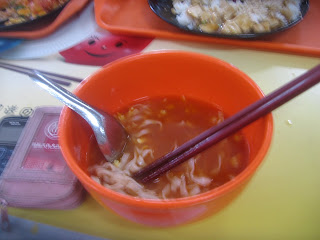
This picture isn't terribly descriptive, due to the fact I forgot to take a picture until I was halfway done. :) However, the name itself is pretty descriptive, and the dish is tame by Chinese standards - not spicy, just a little bit salty.
Ingredients: Noodles, Tomatoes, Tomato Sauce, Eggs, and Cabbage.
(Xi Hong Shi Ji Dan Mian, or Tomato and Egg Noodles)
Price: 4 RMB, 60 cents USD


This picture isn't terribly descriptive, due to the fact I forgot to take a picture until I was halfway done. :) However, the name itself is pretty descriptive, and the dish is tame by Chinese standards - not spicy, just a little bit salty.
Ingredients: Noodles, Tomatoes, Tomato Sauce, Eggs, and Cabbage.
Sunday, November 28, 2010
To Market to Market...
As my time here in Beijing winds down, I've been going to a lot of the different markets to get gifts and souvenirs for everyone at home. It's been fun to go back to the Pearl Market, which was the market I visited during the beginning of my time here. My perception of it has changed quite a bit; it seemed a lot less intimidating and aggressive than last time I was there. Going back to places that I visited much earlier in my time here has also shown me how much my Chinese has improved. I'm so much more willing to interact with the sellers, and rather than just naming a price, I might launch into a longer explanation of why my price is so low. (I'm just a poor student, I have to eat, too!" )
An important thing to note is that you have to bargain at the markets here - if you don't, you'll probably spend 500% more money than you would otherwise. I bought a pair of boots for 100rmb (roughly 15usd), but the seller had started at 680rmb. While most of the stuff I've bought is Christmas presents (and as such, the items and their prices must remain confidential until after December 25th!), I also bought a "Tiffany" bracelet for 45rmb, down from 250. Oh, I also bought a pair of "pearl" earrings for 20rmb and a "cashmere" scarf for 20, too (roughly 3 USD each). Bargaining can be a ton of fun, but also a bit exhausting. Look for my guide to bargaining later in the week, in case your planning a trip to China anytime soon. I also try to write a post on my shady Louis Vuitton experience. :)
As far as the markets themselves go, there's three that I think are the main ones in Beijing: the Pearl, Silk, and Zoo markets. The Pearl and Silk markets are both very similar in that they tend to be oriented towards foreigners (although I've seen Chinese shoppers there, too) and have a lot more kitschy items (ie, Mao's little read book of sayings) and designer knock offs ("Hello Lady, you want to buy a Prada bag? How about Louis Vuitton, okay?). However, I like the Pearl Market better, because the price they start bargaining at tends to be a bit lower, and they just seemed more friendly. The Silk Market is a bit bigger, so has something of a better selection. The Zoo market isn't really a tourist market, and when I went, I didn't see any other foreigners. The Zoo markets sell mainly clothes and daily necessities, so it's usually packed. Not many designer knock offs (except for Uggs), but dirt cheap prices, but so insanely packed, it isn't much fun. Overall, I think the Pearl Market is my favorite, but the Zoo market is great for getting clothes and shoes.
An important thing to note is that you have to bargain at the markets here - if you don't, you'll probably spend 500% more money than you would otherwise. I bought a pair of boots for 100rmb (roughly 15usd), but the seller had started at 680rmb. While most of the stuff I've bought is Christmas presents (and as such, the items and their prices must remain confidential until after December 25th!), I also bought a "Tiffany" bracelet for 45rmb, down from 250. Oh, I also bought a pair of "pearl" earrings for 20rmb and a "cashmere" scarf for 20, too (roughly 3 USD each). Bargaining can be a ton of fun, but also a bit exhausting. Look for my guide to bargaining later in the week, in case your planning a trip to China anytime soon. I also try to write a post on my shady Louis Vuitton experience. :)
As far as the markets themselves go, there's three that I think are the main ones in Beijing: the Pearl, Silk, and Zoo markets. The Pearl and Silk markets are both very similar in that they tend to be oriented towards foreigners (although I've seen Chinese shoppers there, too) and have a lot more kitschy items (ie, Mao's little read book of sayings) and designer knock offs ("Hello Lady, you want to buy a Prada bag? How about Louis Vuitton, okay?). However, I like the Pearl Market better, because the price they start bargaining at tends to be a bit lower, and they just seemed more friendly. The Silk Market is a bit bigger, so has something of a better selection. The Zoo market isn't really a tourist market, and when I went, I didn't see any other foreigners. The Zoo markets sell mainly clothes and daily necessities, so it's usually packed. Not many designer knock offs (except for Uggs), but dirt cheap prices, but so insanely packed, it isn't much fun. Overall, I think the Pearl Market is my favorite, but the Zoo market is great for getting clothes and shoes.
Thanksgiving in the Land of Chopsticks
Happy belated Thanksgiving! While this wasn't my first Thanksgiving away from home, it was my first one outside of the country. As far as Thanksgiving break, our professors pulled a "China" on us - giving us a day off, but requiring us to make up the work. We normally have Wednesday off, but Thanksgiving week we had class on Wednesday, but got Friday off for Thanksgiving break, though we still had class on Thursday. This raises an important philosophical question: when you're thirteen hours ahead of home, does that mean Thanksgiving is Thursday (while it's still primarily Wednesday in the US) or Friday (when it's Thursday there)? The student complaints about not getting Thanksgiving off later proved to be a moot point; on Thursday morning, our TA emailed that our professor was sick, so class was canceled! I still had language class that afternoon, but it meant we got an extra long weekend (4 days, but 5 if you count the field trip on Monday that we have instead of class).
Thanksgiving was largely uneventful, with just language class and too much time watching US television shows online. As a group, we didn't do anything for Thanksgiving, but a few small groups went for Beijing Roast Duck. Asta and Sibei, two of my classmates, invited me along to go eat a real Thanksgiving dinner, prepared by one of the restaurants in San Li Tun, the foreign embassy district. We called ahead for a reservation, but alas, they were completely full, and so we found another restaurant serving Thanksgiving dinner. We hurried back to our dorm from the UChicago center to change/get all spiffied up, and then took to metro to the stop Asta said was closest, in the northeast part of the city. Unfortunately, as we left the subway stop, Asta and Sibei realized neither of them had thought to write down the address or phone number of the restaurant, and I had assumed they had. This problem was only compounded by not knowing the Chinese name of the Marriott hotel, where the restaurant was. We wandered around for about half an hour, and took a taxi who's driver said he knew where it was. We were happy to finally be on our way, right up until the point he pulled up in front of a Sheraton hotel.
We eventually made it to the restaurant, and had a complete Thanksgiving dinner, with green bean casserole, butternut squash soup, and pumpkin pie. :) The only thing missing was mashed potatoes, though we joked about going and getting some from Kentucky Fried Chicken. It was kind of funny (not in a "haha" kind of way, but in a "hmmm, that's very interesting" kind of way - Princess Bride reference, for those of you who didn't recognize it!) to eat with a fork and knife again, but it was great to eat Western style food and hang out in a restaurant where English was spoken. :) Getting there was certainly an adventure that made this Thanksgiving another memorable one. :)
Thanksgiving was largely uneventful, with just language class and too much time watching US television shows online. As a group, we didn't do anything for Thanksgiving, but a few small groups went for Beijing Roast Duck. Asta and Sibei, two of my classmates, invited me along to go eat a real Thanksgiving dinner, prepared by one of the restaurants in San Li Tun, the foreign embassy district. We called ahead for a reservation, but alas, they were completely full, and so we found another restaurant serving Thanksgiving dinner. We hurried back to our dorm from the UChicago center to change/get all spiffied up, and then took to metro to the stop Asta said was closest, in the northeast part of the city. Unfortunately, as we left the subway stop, Asta and Sibei realized neither of them had thought to write down the address or phone number of the restaurant, and I had assumed they had. This problem was only compounded by not knowing the Chinese name of the Marriott hotel, where the restaurant was. We wandered around for about half an hour, and took a taxi who's driver said he knew where it was. We were happy to finally be on our way, right up until the point he pulled up in front of a Sheraton hotel.
We eventually made it to the restaurant, and had a complete Thanksgiving dinner, with green bean casserole, butternut squash soup, and pumpkin pie. :) The only thing missing was mashed potatoes, though we joked about going and getting some from Kentucky Fried Chicken. It was kind of funny (not in a "haha" kind of way, but in a "hmmm, that's very interesting" kind of way - Princess Bride reference, for those of you who didn't recognize it!) to eat with a fork and knife again, but it was great to eat Western style food and hang out in a restaurant where English was spoken. :) Getting there was certainly an adventure that made this Thanksgiving another memorable one. :)
Wednesday, November 24, 2010
No Such Thing as Ancient
Also last Friday, after our morning visit to the Urban Planning Museum, we also went to Qianmen, the area just south of Tiananmen Square. Qianmen street is on the north and south axis of the city, which runs through Tiananmen, the Forbidden City, and now the Olympic Green as well. The street was remodeled as a pedestrian street for the Olympics, and looks insanely cool. We had a guided tour of the area with a Chinese scholar who studies the area, which was really informative.
Right near the entrance to the street is a little Starbucks in a building that looks very traditional - one of the coolest Starbucks I've been in. The whole street looks the way you imagined it looking back in the early 1900s when it was a primary street of the city, with lots of shops and the very first Beijing duck restaurant! It was insanely beautiful and exactly what you would imagine Beijing to look like.
Which is exactly the point.
Prior to the Beijing Olympics, the government decided to make the street a major pedestrian thoroughfare, something of a tourist spot. This plan included widening the street, which isn't exactly easy. You can't just pick buildings up and move them back two feet. Most of the buildings were demolished, and along the entire way, there were two of the 40 or so that were the originals. Everything else had been demolished to make way for a 'cleaner' representation of the past.
But in many ways the street is just a front - behind it, the hutongs (courtyard houses) and older buildings still wind their way in a weird maze, a complete contrast to what's on Qianmen street proper. There's a lot of history behind some of the houses, and people still live in the area, though so much of it has been demolished to make space for newer buildings.
It's something I've thought about recently - so much of the 'history' of Beijing isn't as historical as it would seem. So much of it has either been wrecked in wars (it happens..heck, it happened to the White House!), or demolished, or just fallen into general state of disrepair, and then is rebuilt. The Forbidden City isn't even as old as it would seem - most if it has been restored/rebuilt since the mid 20th century. It's kind of a weird concept to adjust to, that what I'm seeing isn't completely what it was historically. In the case of Qianmen, it's changed dramatically. But maybe if it contains the general idea of the place - the essence, if you will - it's okay? I don't know, it's just something I've been thinking about.
Right near the entrance to the street is a little Starbucks in a building that looks very traditional - one of the coolest Starbucks I've been in. The whole street looks the way you imagined it looking back in the early 1900s when it was a primary street of the city, with lots of shops and the very first Beijing duck restaurant! It was insanely beautiful and exactly what you would imagine Beijing to look like.
Which is exactly the point.
Prior to the Beijing Olympics, the government decided to make the street a major pedestrian thoroughfare, something of a tourist spot. This plan included widening the street, which isn't exactly easy. You can't just pick buildings up and move them back two feet. Most of the buildings were demolished, and along the entire way, there were two of the 40 or so that were the originals. Everything else had been demolished to make way for a 'cleaner' representation of the past.
But in many ways the street is just a front - behind it, the hutongs (courtyard houses) and older buildings still wind their way in a weird maze, a complete contrast to what's on Qianmen street proper. There's a lot of history behind some of the houses, and people still live in the area, though so much of it has been demolished to make space for newer buildings.
It's something I've thought about recently - so much of the 'history' of Beijing isn't as historical as it would seem. So much of it has either been wrecked in wars (it happens..heck, it happened to the White House!), or demolished, or just fallen into general state of disrepair, and then is rebuilt. The Forbidden City isn't even as old as it would seem - most if it has been restored/rebuilt since the mid 20th century. It's kind of a weird concept to adjust to, that what I'm seeing isn't completely what it was historically. In the case of Qianmen, it's changed dramatically. But maybe if it contains the general idea of the place - the essence, if you will - it's okay? I don't know, it's just something I've been thinking about.
How to Feel Like a Rockstar
On Friday, we went on a field trip to the Beijing Urban Planning Museum. While normally pretty empty, it was exceptionally crowded that day, as roughly 500 elementary school children were also on a field trip to the museum. As we got ready to leave, they were all lining up by the door, and I quickly realized what a rockstar must feel like: as we walked out, I could feel lots of little eyes staring at the Americans (which was compounded by the fact that I was right next to Alex, the palest 6'4 person you'll ever see). Finally one worked up the courage to say "Hello!" and I said, "Nihao!". It was like a dam broke loose, and all of a sudden there were tons of children yelling Hello at us and waving madly. It was like being an Asian pop star who is marketed to the 8 to 12 year old group. (insert sarcastic reference to Justin Beiber here)
The museum itself was interesting, there was definitely a strong emphasis on the future of Beijing, which will apparently save tons of energy and have hovercraft cars. We thought the future had already arrived when we went to a short screening of a "4-D" film, though it was actually just a 2-D film on 3 panels, so it was like a panorama, and then your seat shifts and bumps as you "ride" in the hovercraft. One of the slogans I liked was the "Shifting from 'made in China' to 'invented in China'", though another was "The World's Crisis - China's Promise", which included massive green energy overhauls by 2020. They also had a huge miniature city of Beijing, which was really cool; you actually got to see the size of the city (the only other time you could see it like that is from the air, but then you have the "crazy bad" levels of pollution). Overall, it was very awe-inspiring, if everything they're advertising actually comes into practice (which it very likely won't, of course). It definitely seems like there's a large scale plan for the city going forward, which I don't know that we have as much of in the US- do we have urban planning museums? It seems like we just get focused on putting band-aids on all of the problems with our cities, as opposed to looking more long term. Maybe that's the problem with a democracy - you're never entirely certain you're going to be there long term. :) Maybe it gets bogged down in city planning committees, or maybe I just haven't noticed because I live in Montana or in an academic bubble most of the time. :)
The museum itself was interesting, there was definitely a strong emphasis on the future of Beijing, which will apparently save tons of energy and have hovercraft cars. We thought the future had already arrived when we went to a short screening of a "4-D" film, though it was actually just a 2-D film on 3 panels, so it was like a panorama, and then your seat shifts and bumps as you "ride" in the hovercraft. One of the slogans I liked was the "Shifting from 'made in China' to 'invented in China'", though another was "The World's Crisis - China's Promise", which included massive green energy overhauls by 2020. They also had a huge miniature city of Beijing, which was really cool; you actually got to see the size of the city (the only other time you could see it like that is from the air, but then you have the "crazy bad" levels of pollution). Overall, it was very awe-inspiring, if everything they're advertising actually comes into practice (which it very likely won't, of course). It definitely seems like there's a large scale plan for the city going forward, which I don't know that we have as much of in the US- do we have urban planning museums? It seems like we just get focused on putting band-aids on all of the problems with our cities, as opposed to looking more long term. Maybe that's the problem with a democracy - you're never entirely certain you're going to be there long term. :) Maybe it gets bogged down in city planning committees, or maybe I just haven't noticed because I live in Montana or in an academic bubble most of the time. :)
Thursday, November 18, 2010
Let it Snow, Let it Snow....
All day today, it has felt like it's about to snow. The overcast skies, the slight mistiness in the air - it must have been a sign that surely, snow was on its way. However, feeling and reality can be two very different things, as was the case today. It was not preparing to snow, and it was not "foggy" like weather.com said. No, the air quality was just so bad, they don't even have a word to describe it.
Today, the air quality index measured Beijing's air quality as being above 500 - which doesn't sound too terrible, until you realize the index stops at 500. 301 to 500 is considered "hazardous", with effects on the majority of the population. Last night, the index of Beijing peaked at 525. Two hours ago, it was at 503, which the person writing could only characterize as "crazy bad", which is slightly amusing. The irony of it all is that I got this information from the Beijing Air twitter feed - aka, from a website that is blocked in China. The more I think about it, the wackier this gets. You can't make this stuff up!
Responses to the 500 + readings have been varied. Our TA - who kindly sent out the email informing us of the air quality - "believes that this means it's about to start raining coal", and a classmate said it feels like living in a post-apocalyptic world. I liken it more to going to school in a mythical land where you can't see more than a city block, because everything is engulfed in this misty haze. Another of our classmates kindly posted a link to an article about the health effects of smog on my Facebook wall, and suggested perhaps we should take up smoking cigarettes when we get back to Chicago - it would probably be better for our health. I am kind of curious to know what happens if it spikes even higher - do we leave "crazy bad" territory and go into "OMG WE'RE ALL GOING TO DIE!!1!" territory?
Today, the air quality index measured Beijing's air quality as being above 500 - which doesn't sound too terrible, until you realize the index stops at 500. 301 to 500 is considered "hazardous", with effects on the majority of the population. Last night, the index of Beijing peaked at 525. Two hours ago, it was at 503, which the person writing could only characterize as "crazy bad", which is slightly amusing. The irony of it all is that I got this information from the Beijing Air twitter feed - aka, from a website that is blocked in China. The more I think about it, the wackier this gets. You can't make this stuff up!
Responses to the 500 + readings have been varied. Our TA - who kindly sent out the email informing us of the air quality - "believes that this means it's about to start raining coal", and a classmate said it feels like living in a post-apocalyptic world. I liken it more to going to school in a mythical land where you can't see more than a city block, because everything is engulfed in this misty haze. Another of our classmates kindly posted a link to an article about the health effects of smog on my Facebook wall, and suggested perhaps we should take up smoking cigarettes when we get back to Chicago - it would probably be better for our health. I am kind of curious to know what happens if it spikes even higher - do we leave "crazy bad" territory and go into "OMG WE'RE ALL GOING TO DIE!!1!" territory?
Subscribe to:
Posts (Atom)